[lang:en]
[lang:de]? Siehe oben!
On August 14, 2025, threat modeling enthusiasts in the DACH region got together to celebrate their own review of the TMC Hackathon 2025. With seven participants during the summer slump, the group was small but sweet.

@agota.daniel hosted the evening and provided particularly valuable insights from his perspective as a juror.
You can find the complete set of slides here:
The Hackathon - a Party for 55 Teams
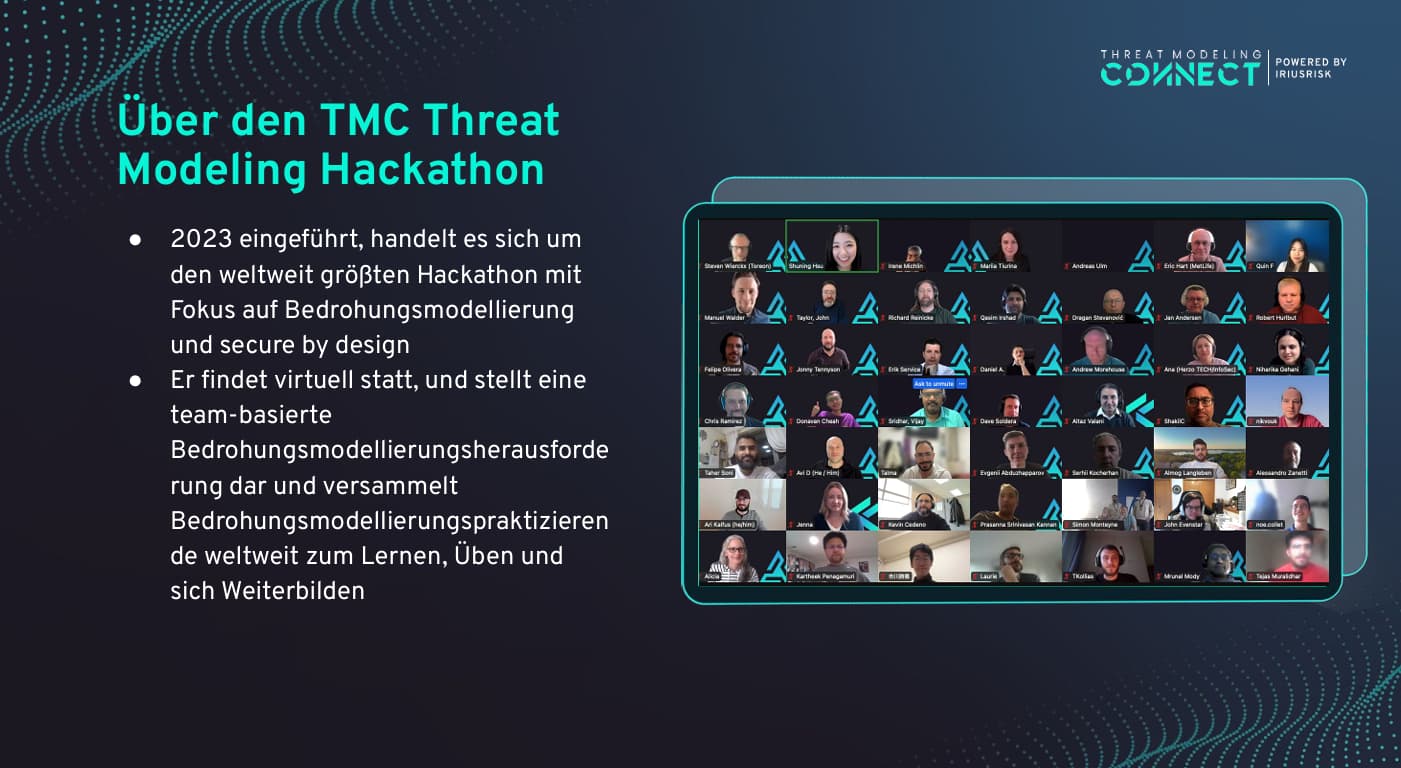
The TMC Hackathon 2025 focused on self-driving cars and presented a challenge in this area. A team from the DACH region also took part. They were in good company, as an impressive total of 55 teams competed! 38 teams actually submitted threat models. Some of the best submissions can be viewed here in the forum:
https://threatmodelingconnect.discourse.group/tags/c/threat-model-examples/26/hackathon-25
Daniel revealed that it was easy to separate the wheat from the chaff: it quickly became clear which models were candidates for victory and which were more interested in learning and experiencing than in the result.
Ways to success 

The very best results, and ultimately the winners, stood out because they were appealing and easy to understand, compact and comprehensible, and sometimes even surprising. It was necessary to look very closely, and the selection was not easy. This became particularly clear when we looked at the winning model and appreciated its clear structure and overview, as well as some special features:
A team should quickly consider whether it is aiming for victory - which then places corresponding demands on output - or whether it is aiming for the best possible learning experience.
Better learning paths 

The Threat Modeling Community could work on making it easier for beginners to get started by providing clear learning paths. Currently, threat modeling is still difficult to access, and Daniel recommends working through a valuable book.
Next time: ready to start. 
@RonMK shared that teams experience significant time losses by first negotiating how they want to work together and what a threat model should look like. A team should be prepared in terms of collaboration and methodology so that a future hackathon challenge can fall on fertile ground and they can dive right into the content. It is also better to work in a focused manner in longer sessions rather than in frequent short ones.
Conclusion
Overall, we can look back on the Hackathon as an intense, enriching, and successful event from the international Threat Modeling Connect Community!
Welcome to our next Threat Modeling After-work! (The event language is  German!)
The next TMC DACH event is another Threat Modeling After-work: The ultra-lightweight method  Fortunately ⇆
  Unfortunately hits the holy grail of security -
  end-to-end encryption. Together, we will look at what makes end-to-end encryption difficult to implement and how it can still be successful. In doing so, we will explore the potential of the Fortunately ⇆ Unfortunately method and whether it could also be something for you. Be there! The event language is German.